
A beautiful hardwood floor can make an older Atlanta home feel finished again, but the wrong product in the wrong room can create avoidable problems. The choice between engineered versus solid hardwood is not only about color, board width, or price. It affects where the floor can be installed, how it responds to seasonal humidity, and how it will serve your household over time.
For many renovation projects, both materials can deliver the warm, natural look homeowners want. The better choice depends on the home’s structure, the condition of the subfloor, the room’s moisture exposure, and whether you are planning a simple flooring update or a larger remodel.
Engineered Versus Solid Hardwood: The Basic Difference
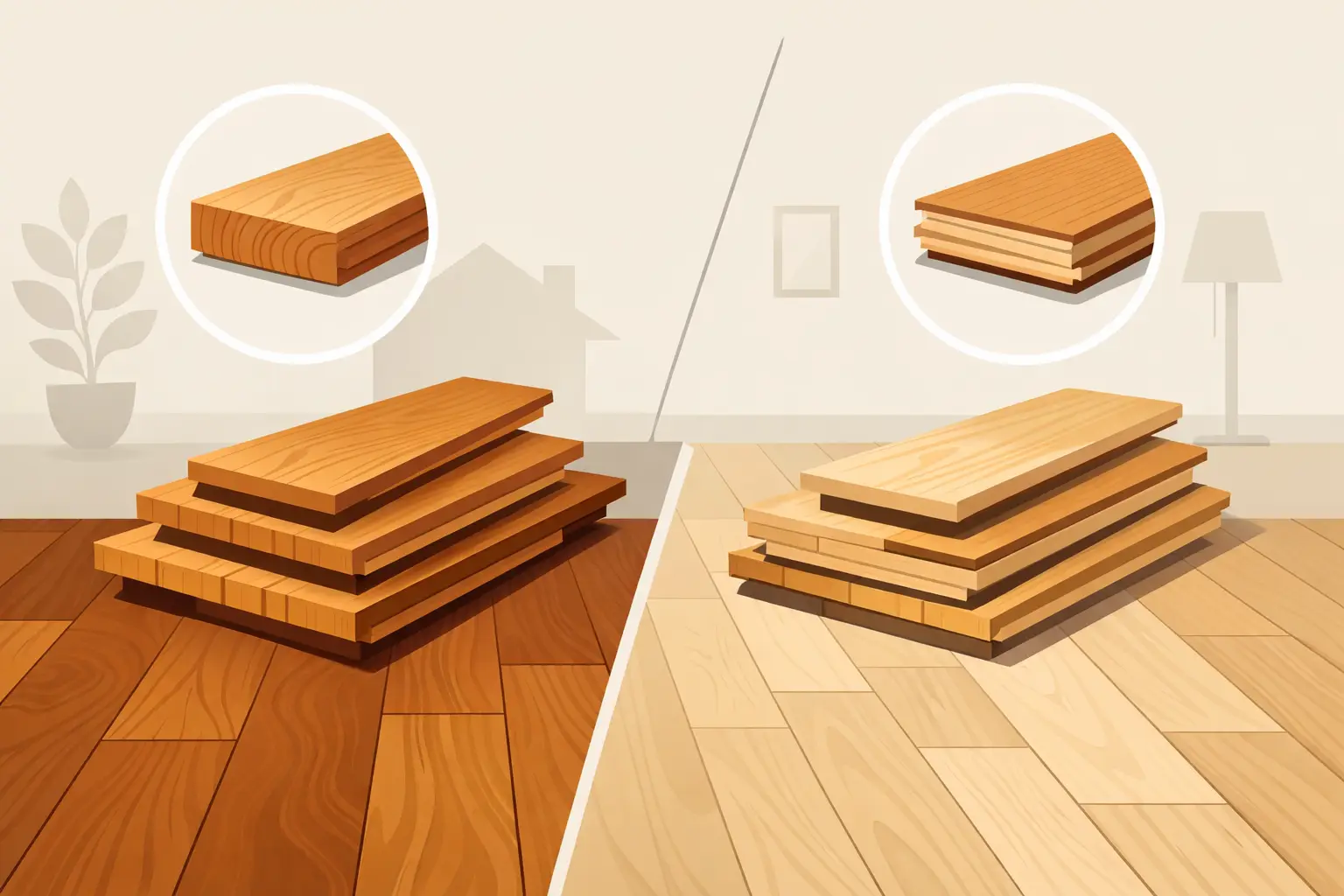
Solid hardwood is exactly what it sounds like: each plank is milled from a single piece of hardwood. Oak, white oak, hickory, maple, and red oak are common choices. Because the wood runs through the full thickness of the board, a solid floor can usually be sanded and refinished several times during its lifespan.
Engineered hardwood has a real hardwood surface, known as a wear layer, bonded over layers of plywood or other stable wood material. It is not laminate flooring and it is not a printed wood image. The surface is genuine wood, with real grain, texture, color variation, and a factory-applied or site-applied finish.
The layered construction is the main difference. It gives engineered flooring greater dimensional stability when indoor humidity changes. Solid wood naturally expands and contracts across its width as it absorbs or releases moisture. Engineered boards still react to their environment, but the cross-layered core limits that movement.
Why Atlanta Conditions Matter
Atlanta homeowners deal with humid summers, rainy periods, and significant swings between air-conditioned interiors and outdoor heat. Those changes do not mean solid hardwood is a bad choice. Solid hardwood has performed well in local homes for generations. They do mean the installation details matter.
A professional installer should check the moisture content of the flooring and subfloor before installation, allow materials to acclimate as required, and leave proper expansion space around the perimeter. Skipping those steps can contribute to gaps, cupping, crowning, or seasonal movement after the work is complete.
Engineered hardwood is often the more forgiving option in areas where moisture conditions are less predictable. It is particularly useful over concrete slabs, in homes with lower-level living spaces, and in renovations where the existing floor height or subfloor limits installation options.
Neither material should be treated as waterproof. A leaking appliance, standing water, wet shoes left by an exterior door, or a plumbing issue can damage both engineered and solid hardwood. The difference is that engineered flooring generally handles ordinary humidity changes more consistently, while solid wood requires a more controlled environment.
Where Each Flooring Type Works Best
Solid hardwood for main living areas
Solid hardwood is a strong choice for above-grade living rooms, dining rooms, bedrooms, hallways, and stair areas with a sound wood subfloor. It brings a traditional feel that suits many Atlanta homes, from older houses being restored to newer homes receiving a high-value interior update.
Homeowners who expect to stay in the house for many years often appreciate the refinishing potential of solid hardwood. Scratches, worn traffic paths, and shifts in design preferences can be addressed by sanding and refinishing the floor instead of replacing it. That long service life is a major advantage when the home is being improved for the long term.
Solid hardwood can also be a practical match when tying new flooring into existing wood floors. An experienced contractor can evaluate the species, width, stain direction, and transition details to make the renovation look intentional rather than patched together.
Engineered hardwood for flexibility
Engineered hardwood works well in most above-grade spaces too, but it has clear advantages where installation conditions are more demanding. It is often selected for concrete slab foundations, lower-level rooms, condominiums, and areas where a thinner profile is needed to meet adjacent flooring or doors.
It can also make sense in an open-concept renovation where flooring runs from a kitchen area into a family room or dining space. Kitchens still require attention around sinks, dishwashers, and spills, but engineered hardwood’s stability can be helpful in a busy household that wants the same natural wood look throughout connected living areas.
Installation method matters. Depending on the product and site conditions, engineered flooring may be glued down, nailed down, floated, or installed using a combination of methods. The best approach is based on the specific flooring product, the subfloor, and the room - not simply what is fastest.
Refinishing Is a Real Trade-Off
The ability to refinish a floor is one of the biggest decision points. A typical solid hardwood floor can be refinished multiple times, assuming it was installed correctly and has not suffered major structural damage. That makes it a durable, repairable surface for families, pets, and high-traffic homes.
Engineered hardwood can also be refinished, but the number of times depends on the thickness of its top veneer. Premium engineered products with thicker wear layers may allow future refinishing. Lower-cost products with thin veneers may have little margin for sanding. A floor should never be aggressively sanded without confirming what the product can handle.
This does not automatically make engineered hardwood a short-term material. A quality engineered floor with a durable finish can perform well for decades when it is maintained properly. It simply requires more care at the selection stage. The product’s wear layer, finish warranty, construction quality, and installation method should be reviewed before deciding.
Cost Depends on More Than the Plank
Comparing material prices alone can be misleading. Solid hardwood and engineered hardwood both come in a wide range of costs based on species, grade, width, finish, board length, and brand. A wide-plank white oak floor will have a different budget than a narrower red oak floor, regardless of whether it is solid or engineered.
Installation conditions can shift the total project cost as well. Solid hardwood may require a wood subfloor and typically needs to be nailed or stapled down. Engineered flooring may require adhesive, moisture-control systems, floor leveling, or concrete preparation. Removing old flooring, repairing damaged subflooring, moving appliances, and adjusting trim can all affect the final scope.
The right question is not, “Which floor is cheapest?” It is, “Which floor gives this room the best result without creating future limitations?” A less expensive material that cannot be installed correctly in the space is not a good value. A higher-quality product installed over a properly prepared subfloor usually delivers a better-looking, longer-lasting result.
Think About the Whole Renovation
Flooring is one of the largest visual surfaces in a home. It should work with the rest of the project, especially when a kitchen, stairway, interior paint plan, deck door, or family-room layout is changing at the same time.
For example, a kitchen remodel may introduce new cabinetry, countertop tones, and appliance locations that change how the flooring needs to flow. A new deck or porch can increase traffic near exterior doors, making durable finishes, good entry mats, and thoughtful transitions more important. If walls are coming down to open rooms, the floor selection should be made early enough to create a consistent look across the expanded space.
Color deserves practical thought too. Very dark floors can show dust and pet hair more readily. Very light finishes can reduce the appearance of dust but may show dark scratches. Natural oak tones, medium browns, and matte finishes are popular because they work across many styles and tend to hide everyday wear better than high-gloss finishes.
How to Make the Final Choice
Choose solid hardwood when you have an above-grade wood subfloor, want maximum refinishing potential, and value a traditional floor built to be renewed over time. It is a dependable choice for living areas, bedrooms, and hallways where moisture is controlled and the home can support conventional nail-down installation.
Choose engineered hardwood when you need more installation flexibility, are working over concrete, need to manage floor height, or want added stability in a humidity-sensitive setting. It is also a good fit when the project calls for wide planks, continuous flooring through connected spaces, or a natural wood surface in a lower-level area.
Before material is ordered, have the room measured, the subfloor evaluated, and the transition points reviewed. That upfront planning is where a flooring project becomes more than a new surface. For Atlanta homeowners updating one room or coordinating a larger renovation, Floor's Leader can help turn the right hardwood choice into a finished space that looks connected, performs well, and feels right for the way the home is used.
Get a free quote from Floor's Leader.